






















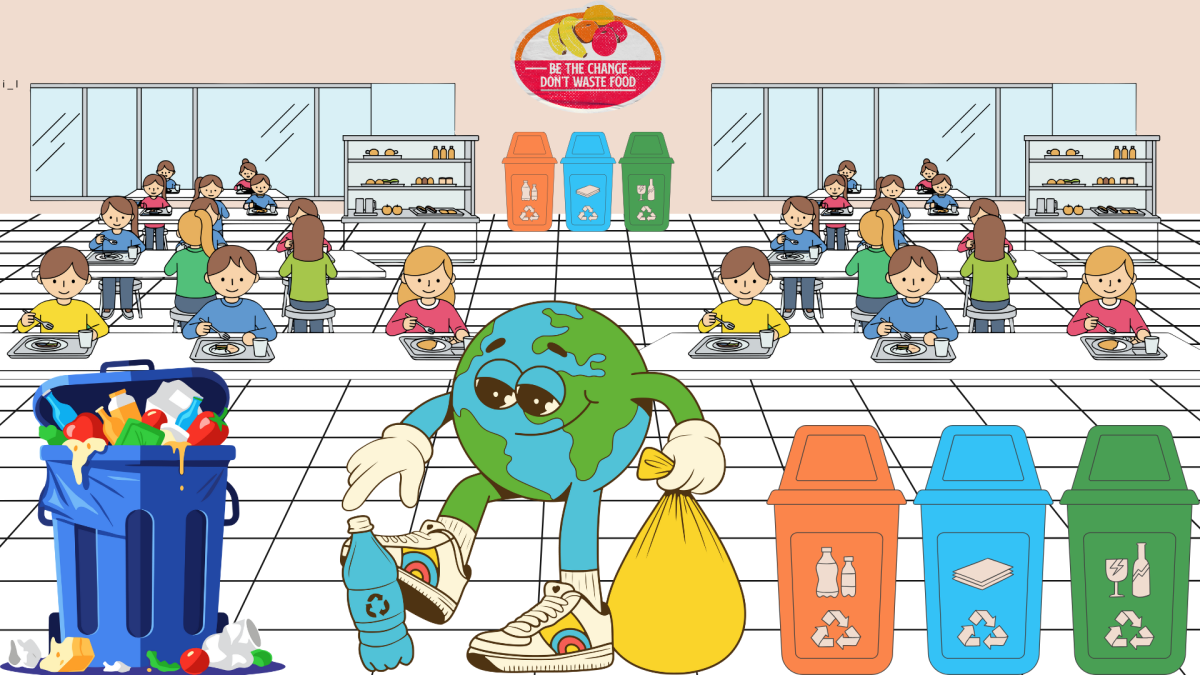
Mount Vernon High School and its community are facing an issue that may seem small, but could play a role in larger, long-term effects if not dealt with. The problem is unnecessary waste, and the ones who need to help tackle the issue are not just the administration but also us students.
Paper waste was originally what caught my attention due to the absence of the blue recycling bins in each classroom over the previous few school years. The school purchased 200 cases of paper last year, and much of it could be recycled after use. But it’s not fully on the school for this lack of paper recycling.
Principal Cory Caughlan explained that, “It was due to the fact that the company we were working with was just nonresponsive, and the things weren’t even getting recycled that we knew of… so that’s when we stopped.”
Subjects such as food waste and recyclables other than paper came up as well as I asked the administration about the reasons behind different wastes at the school. Caughlan led me to Meg Reed – The Director of Food and Nutrition Services for our entire district. She explained to me the food waste situation at the school.
“We’re averaging about 3,000 to 3,100 meals per day,” Reed claimed, “if I had to venture a guess, out of the meals actually prepared, maybe 85-90 [percent] actually get eaten.”
The lunch staff can not control what the student body does and does not eat once it leaves their service lines, but they are required by Ohio law to serve certain types of foods and certain quantities that many students likely will just throw away. While the guidelines are incredibly helpful for students to get the proper nutrition and knowledge on what they need, it is in the hands of the student body as to what happens to the food in the end.
Reed does what she can to counter this waste by donating unused food to local shelters and other sources, but not everything can be accounted for – not just in terms of food but also in terms of utensils. “Everything is served on a disposable platter or plate. fork, spoon, knife – all of that is plastic or foam. That’s always been a concern for myself, rather than using something that’s reusable,” Reed stated.
However, both the faculty and the students of our school can help to make a change regarding many parts of these issues.
“I’d be completely open to [a new recycling company] if somebody had the knowledge or knew of a company we could reach out to,” Caughlan stated. And possible student assistance does not stop there.
As Reed pointed out, students are the main deciders on where the food ends up. And when I asked her about a share-table for the lunch room, Reed stated, “I think it would be valuable,” and, “it would just be a matter of me looking into the state guidelines”.
In addition, if students were interested, they could try to pursue reintroducing a sustainability club in the school to spearhead more actions toward bettering the school’s impact on the environment.
With the help of both the administration looking into more options for the school and students being more mindful of how much they throw away, the waste issue of the school could easily become less and less of an issue.